
Close Menu
Peter Klapwijk – In The Cloud 24-7Peter Klapwijk – In The Cloud 24-7
    Facebook X (Twitter) Instagram
    Peter Klapwijk – In The Cloud 24-7Peter Klapwijk – In The Cloud 24-7
    • Home
    • Intune
    • Windows
      • Modern Workplace
    • macOS
    • Android
    • iOS
    • Automation
      • Logic Apps
      • Intune Monitoring
      • GitHub
    • Security
      • Passwordless
      • Security
    • Speaking
    • About me
    Peter Klapwijk – In The Cloud 24-7Peter Klapwijk – In The Cloud 24-7
    Home»Microsoft365»Manage Microsoft 365 Apps updates with Cloud Update
    Microsoft365

    Manage Microsoft 365 Apps updates with Cloud Update

    Welcome in the wonderful world of Cloud update!
    Peter KlapwijkBy Peter KlapwijkJune 26, 2024Updated:June 27, 202416 Mins Read

    Todays blog post is to make you aware of the possibilities the Cloud update feature of Microsoft offers us in managing Microsoft 365 Apps (the Office suite). The cloud update feature is found in the Microsoft 365 Apps admin center and seems pretty unknown to a lot of IT admins. And to be honest, it was also unknown to me 😊

    Cloud update

    provides advanced management capabilities, offers more comprehensive insights, and gives you better control over your Monthly Channel, and Current Channel updates. This streamlined solution ensures an optimized experience when managing your devices.

    Cloud update currently supports the Enterprise Monthly and Current Channel Office installations. Support for Semi-Annual Channel is planned, and hopefully released soon.

    Cloud update provides us an inventory of all our devices running Microsoft 365 Apps. The inventory information show the Office version, Build and Channel per device. Besides that it shows an inventory of (COM and CSTO) add-ins. And as last it shows if macros are present on the device.

    Besides that, the feature offers us rollout waves for Monthly Enterprise channel. And this is actually the reason cloud update got my attention!

    Cloud update provides as a way to have more control over the updates for the M365 apps. We can compare it a bit with Windows Update for Business.
    With cloud update we have the option to deploy updates for the office suite in several rings (the rollout waves). This means we can deploy updates first to our own department, in the next wave to our application owners for example and in the third wave to our end-users. We can configure the days between waves and a deadline.
    Besides that we have an option to rollback an update with just a few clicks. And we have the option to configure exclusion dates. Update exclusions can be created to prevent devices downloading security and feature updates during specific dates.

    Before you get started with Cloud update, it is good to note the compatibility with other management tools information in the documentation of Microsoft, as Cloud updates takes priority over other management tools.

    Sounds useful, right? Let’s see how this is all configured!

    Requirements

    Before we are going to dive into Cloud update, let’s first check the requirements for this feature.

    The feature is available for admins with a Office Apps Administrator, Security or Global Administrator role.

    Our users need to be licensed with a Office 365 license. This can be part of for example a Microsoft Business Standard license.

    For the most up to date information on the requirements read the Microsoft documentation.

    Enable cloud update

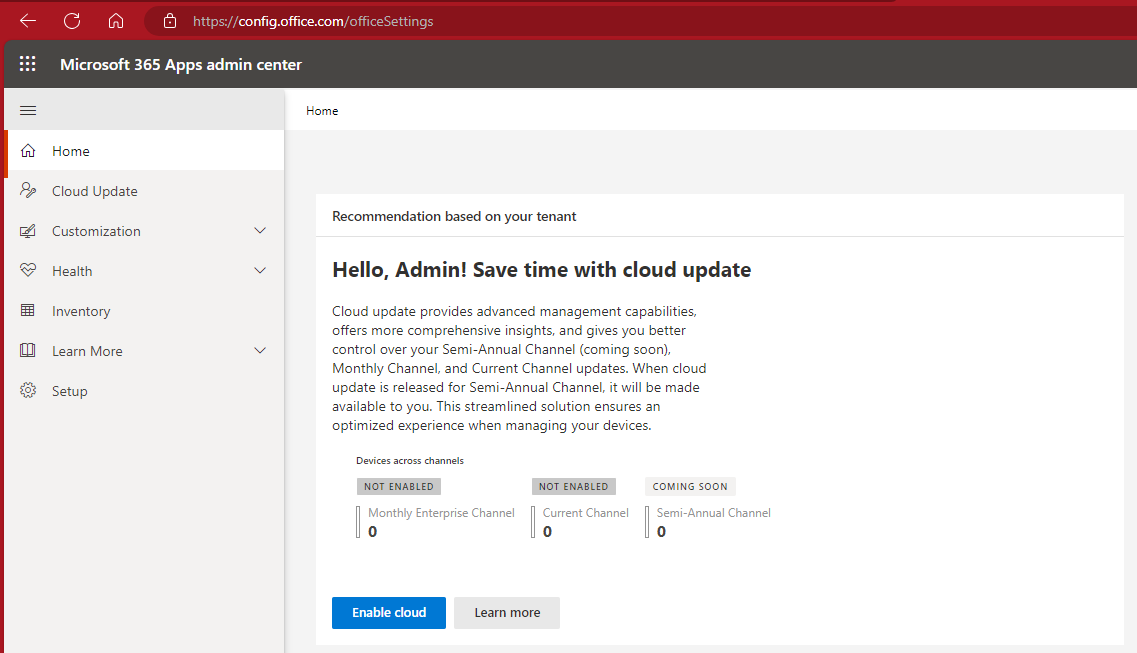
    Cloud update is found in the Microsoft 365 admin center, that is available via config.office.com.

    Cloud update is one of the sections found via the left menu (1).
    To make use of the feature we first need to enable it (2).

    When enabled the home tab shows the number of enabled devices (which is of course none directly after enabling the feature).

    On the Overview page we find a summary of cloud update. It shows a percentage of the devices updated. And from the overview page we can view all the unmanaged devices (2) and all cloud update managed devices (2).

    When we have just enabled cloud update all our devices show up in the inventory (accessed via the previous View unmanaged devices option). It shows the Cloud update status of the devices. The devices first show a status of Onboarding to and the channel specified.

    After some time the status shows with which channel the device is managed. This status could continue until the next update is released, usually on the upcoming patch Tuesday.

    Configure rollout waves

    Waves are found on the the settings page, of the Monthly Enterprise tab section. With waves we can make a ring deployment, like we can implement for Windows Updates. How you implement the number of waves, deadlines and days between waves of course differs per environment.
    You could for example have a number of user run Current channel and implement different waves for Monthly Enterprise.

    By default when you enable waves, wave 1 is the validation wave with a 7-day validation (deadline). You have the option to opt out of update validation.
    You can add three waves yourself with an additional fourth wave containing all remaining devices, not assign one of the waves.

    Click Add waves to add the number of waves you’d like to implement.

    Waves can be assigned to Microsoft Entra groups.

    When waves are added, we can configure the number of days between waves.

    On the next tab we configure the update deadline (a number between 0 and 14 days).

    Monitoring rollout waves

    Now we have configured our rollout waves, we need to monitor those waves and the progress of our devices/ M365 apps.

    On the Monthly Enterprise tab (1) get an overall overview of the number of devices in the waves and the percentage of updated devices.

    We also have the option View Waves overview (2) on this tab.

    The waves overview shows us the start date (1) of every wave.
    It shows the waves status (2), Completed or In progress.
    And it shows the device status (3), like completed, failed or roll back.

    Device actions

    We have a couple of actions we can take on devices. We can roll back the M365 application version and we have the option to switch devices between update channels.

    When we are on the Inventory tab (1) we can browse to All devices.
    Here we have the option to switch the device update channel (2).

    Select the targeted update channel to which the device needs to be switched and click Move devices.

    We can also switch devices in bulk by selecting an Entra group.

    Be aware of the time it can take to process the channel switch.

    On the Monthly Enterprise tab, we have the option to roll back devices to a previous M365 version/ build.

    Search for a device on device name. Select the version to which the application should be rolled back.

    The rollback will be applied within 12-24 hours.

    Via the Monthly Enterprise tab, View all devices option, we can check the rollback status.

    Inventory

    On the Inventory tab we have information available about the different Office builds and channels. We have an overview of the Office architecture and an overview of the add-ins.

    The builds inventory shows the different builds in the environment, including information if these builds are supported or not.

    The channels inventory shows the different builds and number of devices on these builds.

    The devices inventory shows an overall overview of all devices and includes a lot of information.
    It shows the cloud update status, to determine if the device is managed and by which channel.
    But is also shows the Office architecture, version, build and other additional information.

    As last we have the inventory of the add-ins used in the environment.

    Per add-in you can drill-down to get more information about that particular Office add-in.

    That’s it for this blog post to introduce you to Microsoft cloud update.
    I hope you find it informative.
    Thanks for reading!

    Microsoft 365 Office 365 Office suite Windows
    Share. Facebook Twitter LinkedIn Email WhatsApp
    Peter Klapwijk
    • Website
    • X (Twitter)
    • LinkedIn

    Peter is a Security (Intune) MVP since 2020 and is working as Modern Workplace Engineer at Wortell in The Netherlands. He has more than 15 years of experience in IT, with a strong focus on Microsoft technologies like Microsoft Intune, Windows, and (low-code) automation.

    Related Posts

    The next step in a passwordless Windows experience

    October 28, 2023

    Microsoft Defender ATP for Mobile

    June 23, 2020

    Add an Azure AD group to the local administrators group with Microsoft Intune

    April 18, 2020
    View 1 Comment

    1 Comment

    1. Simon Jackson on June 28, 2024 17:12

      Great to see more info about this little known feature out there!
      I stumbled on it about a year ago when it was called Service Profiles and have 100 or so users testing it on the MEC. Main takeaway for us was that update is now virtually invisible in that in just occurs in the background most of the time when M365 Apps aren’t running or (more likely) the device is restarted. We were/are using SCCM to update on the SAEC and it works fine but prompts for a restart which can be pretty annoying if you’ve just done one for the monthly OS updates etc. As you say, its very similar to WUfB with very little admin overhead. I’m planning on using the same groups for both when I roll it out to the whole company 🙂
      Would be nice to have it integrated into the Intune portal though to make life even easier!

      Reply
    Leave A Reply Cancel Reply

    Peter Klapwijk

    Hi! Welcome to my blog post.
    I hope you enjoy reading my articles.

    Hit the About Me button to get in contact with me or leave a comment.

    Awards
    Sponsor
    Latest Posts

    Intune PowerShell script installer feature

    January 17, 2026

    Configuring the time zone with Intune, what are our options?

    January 9, 2026

    Configure Azure file shares for Entra joined Windows devices and cloud identities

    December 19, 2025

    Managing Windows 365 Link devices with Intune

    October 24, 2025
    follow me
    • Twitter 4.8K
    • LinkedIn 6.1K
    • YouTube
    • Bluesky 1.5K
    Tags
    Administrative Templates Android Automation Autopilot Azure Azure AD Browser Conditional Access Edge EMS Exchange Online Feitian FIDO2 Flow Graph Graph API Identity Management Intune Intune Monitoring iOS KIOSK Logic Apps macOS MEM MEMMonitoring Microsoft 365 Microsoft Defender Microsoft Edge Microsoft Endpoint Manager Modern Workplace Office 365 OneDrive for Business Outlook Passwordless PowerApps Power Automate Security SharePoint Online Windows Windows 10 Windows10 Windows 11 Windows 365 Windows Autopilot Windows Update
    Awards
    Sponsor
    Follow me on Twitter
    Tweets by inthecloud_247
    Tags
    Administrative Templates Android Automation Autopilot Azure Azure AD Browser Conditional Access Edge EMS Exchange Online Feitian FIDO2 Flow Graph Graph API Identity Management Intune Intune Monitoring iOS KIOSK Logic Apps macOS MEM MEMMonitoring Microsoft 365 Microsoft Defender Microsoft Edge Microsoft Endpoint Manager Modern Workplace Office 365 OneDrive for Business Outlook Passwordless PowerApps Power Automate Security SharePoint Online Windows Windows 10 Windows10 Windows 11 Windows 365 Windows Autopilot Windows Update
    Archives
    Peter Klapwijk

    Hi! Welcome to my blog post.
    I hope you enjoy reading my articles.

    Hit the About Me button to get in contact with me or leave a comment.

    Copy right

    This information is provided “AS IS” with no warranties, confers no rights and is not supported by the authors, or In The Cloud 24-7.


    Copyright © 2025 by In The Cloud 24-7/ Peter Klapwijk. All rights reserved, No part of the information on this web site may be reproduced or posted in any form or by any means without the prior written permission of the publisher.

    Shorthand; Don’t pass off my work as yours, it’s not nice.

    Recent Comments
    • Artin on Onboarding a passwordless Azure AD user
    • George on Configure Azure file shares for Entra joined Windows devices and cloud identities
    • Ganesh sekarbabu on Configure Azure file shares for Entra joined Windows devices and cloud identities
    • John on Connect to Azure file shares with Microsoft Entra Private Access
    • Luis on Application installation issues; Download pending
    most popular

    Application installation issues; Download pending

    October 1, 2024

    How to change the Windows 11 language with Intune

    November 11, 2022

    Restrict which users can logon into a Windows 10 device with Microsoft Intune

    April 11, 2020

    How I solved a strange Kerberos issue

    December 12, 2024
    Recent Comments
    • Artin on Onboarding a passwordless Azure AD user
    • George on Configure Azure file shares for Entra joined Windows devices and cloud identities
    • Ganesh sekarbabu on Configure Azure file shares for Entra joined Windows devices and cloud identities
    • John on Connect to Azure file shares with Microsoft Entra Private Access
    • Luis on Application installation issues; Download pending
    Copy right

    This information is provided “AS IS” with no warranties, confers no rights and is not supported by the authors, or In The Cloud 24-7.

    Copyright © 2023 by In The Cloud 24-7/ Peter Klapwijk. All rights reserved. No part of the information on this web site may be reproduced or posted in any form or by any means without the prior written permission of the publisher.

    Shorthand: Don’t pass off my work as yours, it’s not nice.

    Peter Klapwijk – In The Cloud 24-7
    X (Twitter) LinkedIn YouTube RSS Bluesky
    © 2026 ThemeSphere. Designed by ThemeSphere.

    Type above and press Enter to search. Press Esc to cancel.

    Manage Cookie Consent
    To provide the best experiences, we use technologies like cookies to store and/or access device information. Consenting to these technologies will allow us to process data such as browsing behavior or unique IDs on this site. Not consenting or withdrawing consent, may adversely affect certain features and functions.
    Functional Always active
    The technical storage or access is strictly necessary for the legitimate purpose of enabling the use of a specific service explicitly requested by the subscriber or user, or for the sole purpose of carrying out the transmission of a communication over an electronic communications network.
    Preferences
    The technical storage or access is necessary for the legitimate purpose of storing preferences that are not requested by the subscriber or user.
    Statistics
    The technical storage or access that is used exclusively for statistical purposes. The technical storage or access that is used exclusively for anonymous statistical purposes. Without a subpoena, voluntary compliance on the part of your Internet Service Provider, or additional records from a third party, information stored or retrieved for this purpose alone cannot usually be used to identify you.
    Marketing
    The technical storage or access is required to create user profiles to send advertising, or to track the user on a website or across several websites for similar marketing purposes.
    • Manage options
    • Manage services
    • Manage {vendor_count} vendors
    • Read more about these purposes
    View preferences
    • {title}
    • {title}
    • {title}