
Close Menu
Peter Klapwijk – In The Cloud 24-7Peter Klapwijk – In The Cloud 24-7
    Facebook X (Twitter) Instagram
    Peter Klapwijk – In The Cloud 24-7Peter Klapwijk – In The Cloud 24-7
    • Home
    • Intune
    • Windows
      • Modern Workplace
    • macOS
    • Android
    • iOS
    • Automation
      • Logic Apps
      • Intune Monitoring
      • GitHub
    • Security
      • Passwordless
      • Security
    • Speaking
    • About me
    Peter Klapwijk – In The Cloud 24-7Peter Klapwijk – In The Cloud 24-7
    Home»Modern Workplace»Configure Azure file shares for Entra joined Windows devices and cloud identities
    Modern Workplace

    Configure Azure file shares for Entra joined Windows devices and cloud identities

    Peter KlapwijkBy Peter KlapwijkDecember 19, 2025Updated:December 19, 20254 Mins Read

    Today, I share a blog post on how we can enable Kerberos authentication for cloud-only identities on Azure file shares. Azure file shares can come handy when a file share is needed from every location and working with a cloud managed device, but till a short while back we could only enable Kerberos authentication for hybrid user identities like I wrote in this article. For a company working with cloud managed devices and cloud-only users, there wasn’t a Microsoft solution to authenticate against an Azure file share. But time changes and so do the solutions of Microsoft, so lets have a look at how we can set this up.

    Requirements

    There are some requirements to work with Azure file shares and cloud-only identities:

    • Windows 11 Enterprise/Pro
    • Cloud-only identity
    • Default share-level permissions
    • Disable MFA

    You must disable multifactor authentication (MFA) on the Microsoft Entra app representing the storage account, it is just not supported for Azure file shares. But to secure access to the Azure file shares we can use other requirements in Conditional Access policies, but more on that later in this post.
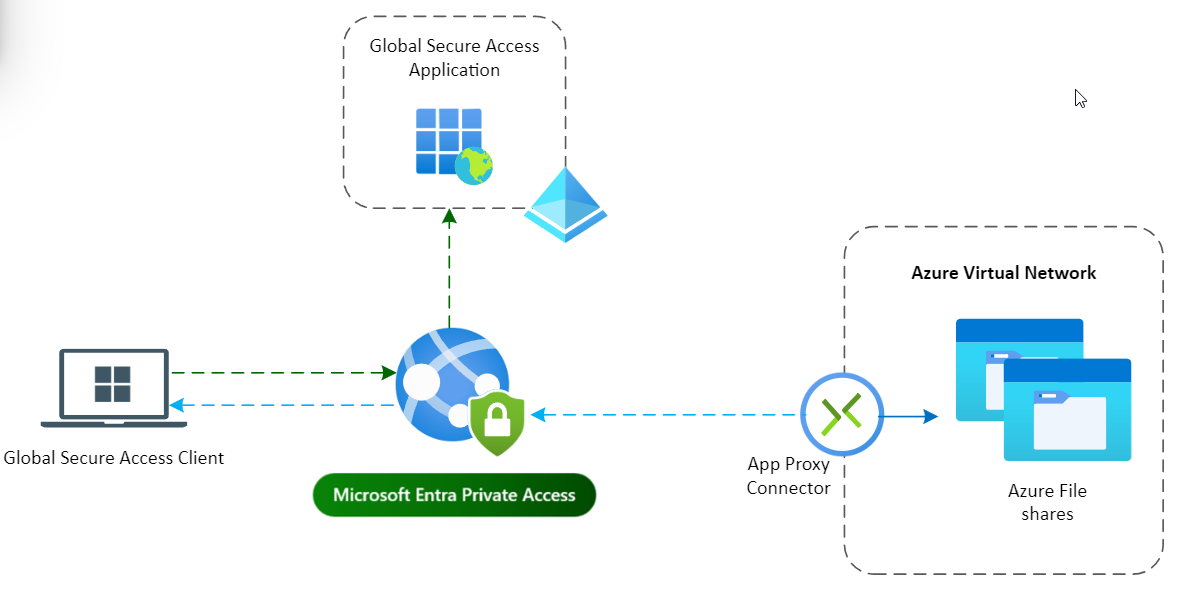
    We could also use Microsoft Entra Private Access and only allow access to the file share via this solution, which might also become handy for users from which the ISP blocks SMB port 445.

    Enable Microsoft Entra Kerberos authentication for cloud-only user accounts

    I assume you know how to create a storage account with a file share and therefor directly move to configuring Kerberos authentication on the file share. If not, please refer to my previous article where it is described.

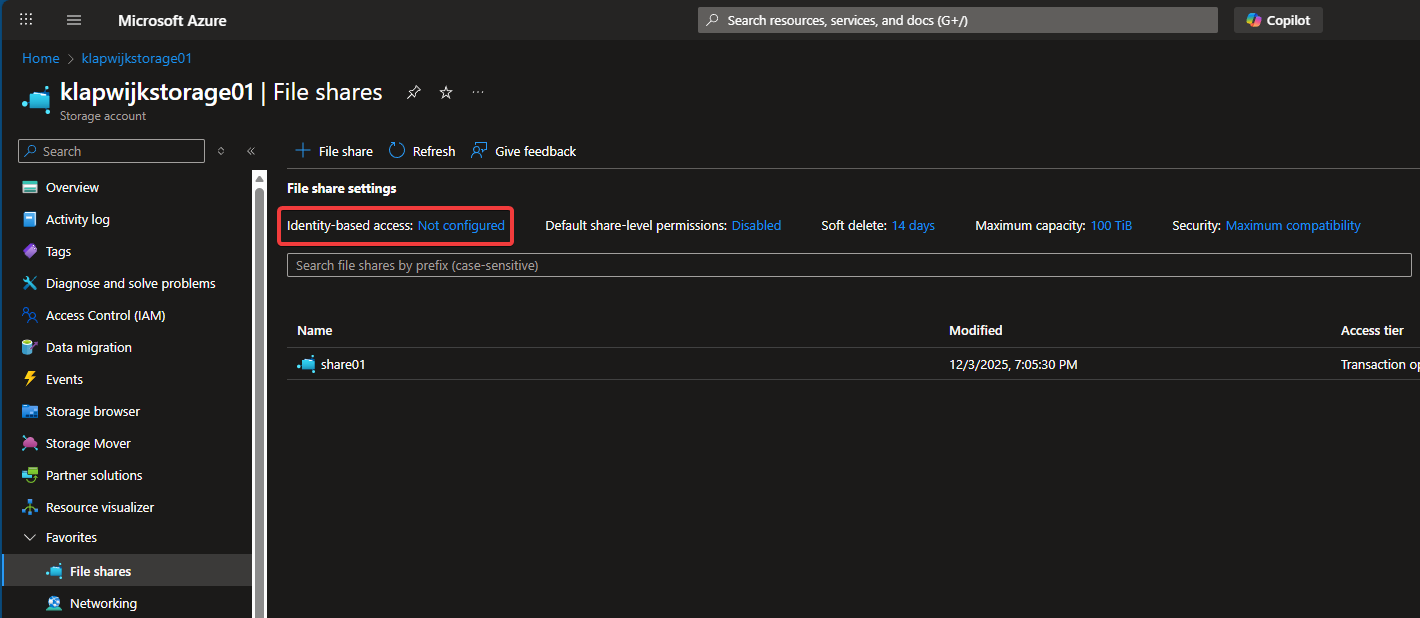
    On the Files shares tab (under Data storage) click on Not configured which is shown behind Identity-based access.
    Click Setup under Microsoft Entra Kerberos.
    Set a checkmark behind Microsoft Entra Kerberos and click Save.

    The most challenging part for me was configuring sharing permissions, as I didn’t read the docs.
    I was used to setup more fine-grained share permissions on the file share level and not use default share-level permissions.

    So make sure to select Enable permissions for all authenticated users and groups and select the appropriate role.

    Grant admin consent to the new service principal

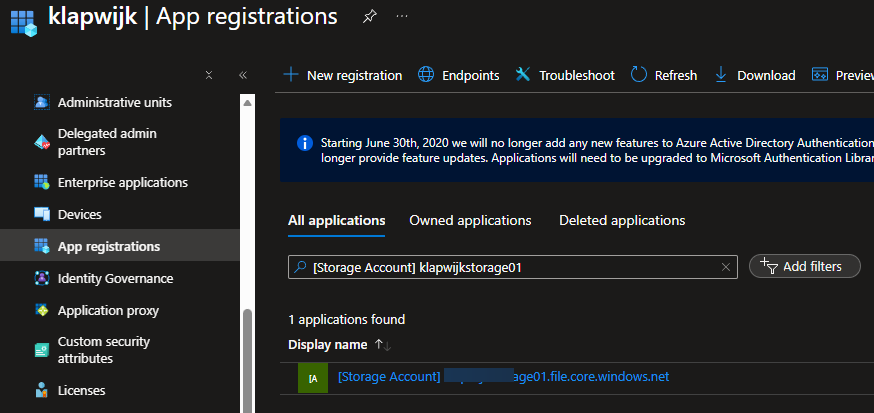
    In the background, a Microsoft Application was registered in Microsoft Entra ID when we enabled Kerberos authentication. We need to explicitly grant admin consent to the new Microsoft Entra application, which is the next step in our setup.

    Browse to App registrations in the Azure portal and to the All applications tab. Search for [storage and you will find the automatically created application. Select the application with the name matching [Storage Account] .file.core.windows.net.
    On the Permissions tab click Grant admin consent for [domain name] to grant the requested API permissions. Click Yes for a confirmation.

    Configure Conditional Access policies

    As we can read in the documentation multi-factor authentication is not supported. This means we need to make sure no MFA is required for the previously created Microsoft Azure application.

    If you for example require MFA for All cloud apps in a Conditional Access policy, you need to exclude the application from the CA policy.

    But the availability of the App registration also allows us to include the app in our Conditional Access policies and require a compliant device to access our Azure file shares.
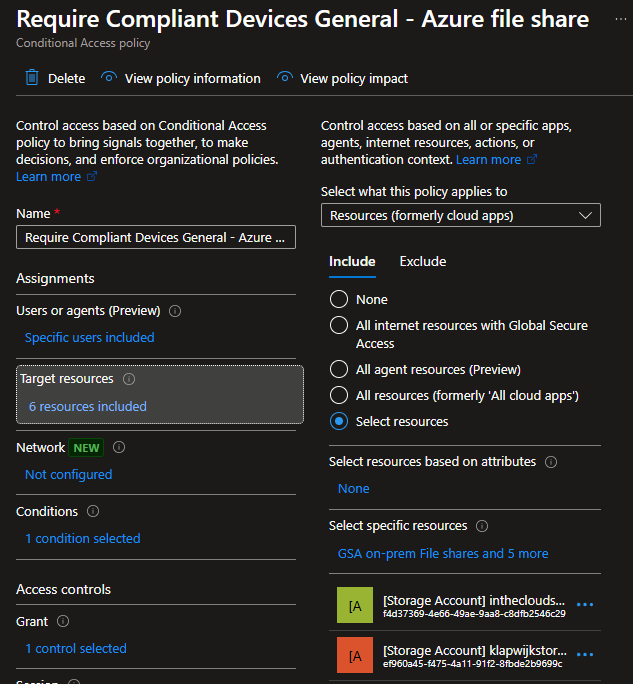
    And as we can see in the sign-in logs from my account, the CA policy is triggered when I want to reach the Azure file share.

    If you want to further secure access to the file share you can block public access to the storage account and allow access via Microsoft Entra Private Access.
    To read more about that, read this post.
    That’s it for this post.
    Thanks for reading!

    Modern Workplace Windows Windows 10 Windows 11
    Share. Facebook Twitter LinkedIn Email WhatsApp
    Peter Klapwijk
    • Website
    • X (Twitter)
    • LinkedIn

    Peter is a Security (Intune) MVP since 2020 and is working as Modern Workplace Engineer at Wortell in The Netherlands. He has more than 15 years of experience in IT, with a strong focus on Microsoft technologies like Microsoft Intune, Windows, and (low-code) automation.

    Related Posts

    Automatically inform your users on outdated Windows devices

    May 8, 2024

    Azure AD Connect setup error

    January 4, 2024

    The next step in a passwordless Windows experience

    October 28, 2023
    Add A Comment
    Leave A Reply Cancel Reply

    Peter Klapwijk

    Hi! Welcome to my blog post.
    I hope you enjoy reading my articles.

    Hit the About Me button to get in contact with me or leave a comment.

    Awards
    Sponsor
    Latest Posts

    Managing Windows 365 Link devices with Intune

    October 24, 2025

    Hard drive and partitions are not shown while installing Windows

    October 14, 2025

    Intune compliance for Windows 365 Cloud PCs

    September 12, 2025

    Intune connector for Active Directory configuration error

    August 29, 2025
    follow me
    • Twitter 4.8K
    • LinkedIn 6.1K
    • YouTube
    • Bluesky 1.5K
    Tags
    Administrative Templates Android Automation Autopilot Azure Azure AD Browser Conditional Access Edge EMS Exchange Online Feitian FIDO2 Flow Graph Graph API Identity Management Intune Intune Monitoring iOS KIOSK Logic Apps macOS MEM MEMMonitoring Microsoft 365 Microsoft Defender Microsoft Edge Microsoft Endpoint Manager Modern Workplace Office 365 OneDrive for Business Outlook Passwordless PowerApps Power Automate Security SharePoint Online Windows Windows 10 Windows10 Windows 11 Windows 365 Windows Autopilot Windows Update
    Awards
    Sponsor
    Follow me on Twitter
    Tweets by inthecloud_247
    Tags
    Administrative Templates Android Automation Autopilot Azure Azure AD Browser Conditional Access Edge EMS Exchange Online Feitian FIDO2 Flow Graph Graph API Identity Management Intune Intune Monitoring iOS KIOSK Logic Apps macOS MEM MEMMonitoring Microsoft 365 Microsoft Defender Microsoft Edge Microsoft Endpoint Manager Modern Workplace Office 365 OneDrive for Business Outlook Passwordless PowerApps Power Automate Security SharePoint Online Windows Windows 10 Windows10 Windows 11 Windows 365 Windows Autopilot Windows Update
    Archives
    Peter Klapwijk

    Hi! Welcome to my blog post.
    I hope you enjoy reading my articles.

    Hit the About Me button to get in contact with me or leave a comment.

    Copy right

    This information is provided “AS IS” with no warranties, confers no rights and is not supported by the authors, or In The Cloud 24-7.


    Copyright © 2025 by In The Cloud 24-7/ Peter Klapwijk. All rights reserved, No part of the information on this web site may be reproduced or posted in any form or by any means without the prior written permission of the publisher.

    Shorthand; Don’t pass off my work as yours, it’s not nice.

    Recent Comments
    • John on Connect to Azure file shares with Microsoft Entra Private Access
    • Luis on Application installation issues; Download pending
    • AndrewWak on Issues syncing SharePoint Online libraries with OneDrive for Mac
    • Peter Klapwijk on Deploy Microsoft Defender updates in deployment rings
    • Magnus on Deploy Microsoft Defender updates in deployment rings
    most popular

    Application installation issues; Download pending

    October 1, 2024

    How to change the Windows 11 language with Intune

    November 11, 2022

    Restrict which users can logon into a Windows 10 device with Microsoft Intune

    April 11, 2020

    How I solved a strange Kerberos issue

    December 12, 2024
    Recent Comments
    • John on Connect to Azure file shares with Microsoft Entra Private Access
    • Luis on Application installation issues; Download pending
    • AndrewWak on Issues syncing SharePoint Online libraries with OneDrive for Mac
    • Peter Klapwijk on Deploy Microsoft Defender updates in deployment rings
    • Magnus on Deploy Microsoft Defender updates in deployment rings
    Copy right

    This information is provided “AS IS” with no warranties, confers no rights and is not supported by the authors, or In The Cloud 24-7.

    Copyright © 2023 by In The Cloud 24-7/ Peter Klapwijk. All rights reserved. No part of the information on this web site may be reproduced or posted in any form or by any means without the prior written permission of the publisher.

    Shorthand: Don’t pass off my work as yours, it’s not nice.

    Peter Klapwijk – In The Cloud 24-7
    X (Twitter) LinkedIn YouTube RSS Bluesky
    © 2025 ThemeSphere. Designed by ThemeSphere.

    Type above and press Enter to search. Press Esc to cancel.

    Manage Cookie Consent
    To provide the best experiences, we use technologies like cookies to store and/or access device information. Consenting to these technologies will allow us to process data such as browsing behavior or unique IDs on this site. Not consenting or withdrawing consent, may adversely affect certain features and functions.
    Functional Always active
    The technical storage or access is strictly necessary for the legitimate purpose of enabling the use of a specific service explicitly requested by the subscriber or user, or for the sole purpose of carrying out the transmission of a communication over an electronic communications network.
    Preferences
    The technical storage or access is necessary for the legitimate purpose of storing preferences that are not requested by the subscriber or user.
    Statistics
    The technical storage or access that is used exclusively for statistical purposes. The technical storage or access that is used exclusively for anonymous statistical purposes. Without a subpoena, voluntary compliance on the part of your Internet Service Provider, or additional records from a third party, information stored or retrieved for this purpose alone cannot usually be used to identify you.
    Marketing
    The technical storage or access is required to create user profiles to send advertising, or to track the user on a website or across several websites for similar marketing purposes.
    • Manage options
    • Manage services
    • Manage {vendor_count} vendors
    • Read more about these purposes
    View preferences
    • {title}
    • {title}
    • {title}